Showing posts with label Arduino. Show all posts

Wednesday, November 25, 2009

The Jedi Mind Trick

"The Jedi Mind Trick" started with a Star Wars "Return Of The Jedi" soundtrack cassette I found at a thrift store. Playing around with the case, I realized that playing cards fit almost perfectly inside, if you remove a few plastic stubs from the interior. The stand is a soap container from Walmart. A strong LED lights up in the center. The sound is from a musical greeting card. Everything, including the rise of the card, is perfectly synchronized to the music, with the help of a micro-controller.


Wednesday, November 11, 2009

War, Love and Peace

"War, Love and Peace" was made using the shell of an old RCA radio. Using a web application (Processing) and an Arduino micro-controller, I was able to create a sort of online hit counter. The computer goes online to a specific website - I used http://thelede.blogs.nytimes.com/ - and counts how many times the words war, love, and peace appear. It returns the result to the web application. The application translates the data to the micro-controller. The micro-controller displays the value on the analog gauges and the red LED. The large gauge is for "war," the small gauge is for "peace," and the red LED is for "love." There is also an LCD screen that displays the words "war," "love," and "peace" every time it receives it. The program updates every ten seconds. If the New York Times blog posts something new, the machine will also update. Mechanically, what once controlled the tone of the radio now controls the contrast of the LCD screen. What controlled the volume now turns the hands of the clock backwards and brightens the large lightbulb. This project was inspired by the last chapter in Massimo Banzi's book, Getting started with Arduino. I chose to make this piece interact with the New York Times blog page, because it is one of the most current world news sources on the web. I tried the project with several major news sites, in fact, and concluded that war is consistenly the most common word in news out of "war," "love," and "peace."




Friday, September 25, 2009

The Email Notifier


"The Email Notifier" was inspired by:
http://www.j4mie.org/2008/02/15/how-to-make-a-physical-gmail-notifier/ and http://blog.tinyenormous.com/2008/11/25/gmail-notifier-project-for-dummies/

This is something I have been trying to figure out for over three years!. To have physical objects like a bell, lights, and a gauge alert you when you get an email is a really complicated thing to figure out. There is a python script that checks for any new mail. There is also another script that prompts the python script to continuously check for new mail instead of just checking once, and there is a third script written out for a micro-controller to listen, wait, and take action when it receives news. The micro-controller has the bell, lights, and gauge attached to it. It is amazing to see it all in action. The links above only got me so far. I had to write a whole new code for my micro-controller. Once I did that, I was able to add the bell, gauge, and 2 vintage style light-bulbs. The best part about writing the code for the micro-controller was the freedom to make endless patterns. When I get an email now, one light-bulb blinks, then the gauge points to the other light-bulb and it blinks; this is repeated twice and ends with the bell ringing. The casing is from an old alarm clock, the gauge is from a multi-meter, and the electronics are held together by an Arduino and Arduino motor shield. This is by far one of my favorite projects. Any questions about making your own, write me at suitcasemachine@gmail.com. Or, even if you don't have any questions, email me anyway, just to activate The Email Notifier!


Friday, July 10, 2009

The Music Box

Michael Schaffer, creator of software program Ardrumo (http://code.google.com/p/ardrumo/), was a great help and inspiration for this project, "The Music Box." Michael made an electronic drum kit using foam circles, some sensors, and an Arduino. Then he wrote a program to translate the sensors into Garageband. The result was a complete homemade drumkit DIY style with the option to change the sounds. I took his sensor idea and built it into a cigar box. All the sensors are hidden, so it makes it more of a mystery music box. It is all self-contained, and the options are endless. I have preset sounds like Mozart the Dove singing, my dog barking, and me whistling. So when I tap on a certain side of the box a different sound plays. Happy birthday Nikola Tesla! :)


Thursday, May 14, 2009

The Audio Portrait Artist

This is "The Audio Portrait Artist"(TAPA). It is made from recycled DC motors, cigar boxes, pieces from a broken multimeter, roof shingles, wine corks, and old radio knobs. TAPA works similar to a CNC machine, but instead of cutting things, it draws . There are four microphones which are each individually filtered to sense a certain range of sound. Starting from very low deep sounds to high pitches, TAPA draws in a specific direction based on the pitch it hears. There are four control knobs on top to control the sensitivity of each mic. Each microphone is individually amplified using LM386N IC chips, and a ULN2003A IC chip bring both DC motors together. There are two relays that control the direction for both motors. The analog gauge is wired together with the circuit to show the intensity of sound it receives.


Wednesday, May 13, 2009

Introducing Oscar with an A

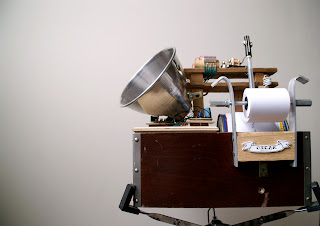
This is a drawing machine made from recycled objects. The heart of "Oscar with an A" is an Arduino microcontroller. The machine senses sound and translates it into drawing.