Sunday, December 26, 2010

Stan Laurel marionette

Stan Laurel is a marionette. His head, hands and feet are all hand carved from wood. The suit was purchased and was intended for a new born child. I had to cut and re-sew everything so it would fit comfortably. Stan Laurel has controlled eyebrows, mouth, and hat. They are all controlled with springs, strings, and dowels. Rope holds the head, hands, and feet together. The marionette string is a multi-stranded bracelet string.


Tuesday, November 23, 2010

mint box card trick


Mint Box Card Trick is built inside of an Altoids tin. There is a wooden frame inside. The handle is made of wire from an old hanger and an eraser. A carved wine cork keeps the hole sealed on top. A few other sneaky things make the selected card rise. Everything needed for this trick is inside the tin. Everything, including the cards, fit to make this effect all self-contained.


Friday, April 23, 2010

Ball Box

"Ball Box" is made from repurposed cigar boxes, bottle caps, and wine cork. The foundation of the box is made from pine. The box's interior uses traditional magic principles for vanishing an object. The hinges for the doors on either side are made from a clothing hanger. The wire was cut and pressed in to fit from the top and bottom, so the doors can swing freely.


Thursday, February 18, 2010

The Dream Box

"The Dream Box" is made in a repurposed Upper Cut cigar box. I used leather, brass, different foam boards, and cardstock to build the inside and outside. The handle is made from a wire clothes hanger. There is woodburning done on the front, and it's glossed over with ModgePodge. This box is the beginning of something I have always wanted to make: to have someone name any card, then to turn a handle on a box, and have that card appear. Watch the video, and let me know what you think! I'm curious to know how this holds up before I really start trying to perform it.


Friday, January 15, 2010

The Miniature Lightning Box

"The Miniature Lightning Box" is made from the insides of a compact fluorescent light bulb (CFL) and an old TV flyback transformer. The circuit inside of the CFL can generate high frequency currents that are fed into a high frequency transformer inside the base of the bulb. The high frequency transformer boosts the voltage so the fluorescent bulb can light up. The TV transformer makes high voltage and high frequency current to generate enough electricity to trace the electron beam that lights up the screen. When you take the CFL's transformer and replace the fluorescent bulb for the TV transformer, you can create well over 1,000 volts! this is my version of a high voltage supply/Jacob's Ladder. I love this project because the spring animates along with the electricity.


Wednesday, December 16, 2009

The Nickel Box

"The Nickel Box" was made from copper, wood, bolts, screws, epoxy, scrap metal, skeleton key, paint, and nails. The tiny box was made from scratch, using scrap wood from another cigar box. All of the copper was hand cut to fit the box. I love this routine, because no electricity is required for it to work. The goal of this project was to create a magic effect that works like a crank toy.


Wednesday, November 25, 2009

The Jedi Mind Trick

"The Jedi Mind Trick" started with a Star Wars "Return Of The Jedi" soundtrack cassette I found at a thrift store. Playing around with the case, I realized that playing cards fit almost perfectly inside, if you remove a few plastic stubs from the interior. The stand is a soap container from Walmart. A strong LED lights up in the center. The sound is from a musical greeting card. Everything, including the rise of the card, is perfectly synchronized to the music, with the help of a micro-controller.


Wednesday, November 11, 2009

War, Love and Peace

"War, Love and Peace" was made using the shell of an old RCA radio. Using a web application (Processing) and an Arduino micro-controller, I was able to create a sort of online hit counter. The computer goes online to a specific website - I used http://thelede.blogs.nytimes.com/ - and counts how many times the words war, love, and peace appear. It returns the result to the web application. The application translates the data to the micro-controller. The micro-controller displays the value on the analog gauges and the red LED. The large gauge is for "war," the small gauge is for "peace," and the red LED is for "love." There is also an LCD screen that displays the words "war," "love," and "peace" every time it receives it. The program updates every ten seconds. If the New York Times blog posts something new, the machine will also update. Mechanically, what once controlled the tone of the radio now controls the contrast of the LCD screen. What controlled the volume now turns the hands of the clock backwards and brightens the large lightbulb. This project was inspired by the last chapter in Massimo Banzi's book, Getting started with Arduino. I chose to make this piece interact with the New York Times blog page, because it is one of the most current world news sources on the web. I tried the project with several major news sites, in fact, and concluded that war is consistenly the most common word in news out of "war," "love," and "peace."




Wednesday, October 14, 2009

Drawing Automaton

The "Drawing Automaton" is a drawing machine that is powered by magnets. Inside there is a plastic cylinder that spins as you turn the handle. Around the cylinder are small magnets placed in random spots. The wires holding the pen are held together by springs which are pulled by fishing line. The line also has magnets attached. As you turn the handle, the magnets from the line attach themselves to the cylinder, and the tension causes the springs to expand, making the pen move. I challenged myself to create a hand turning machine that can draw in every direction. Though the drawings are random, I still consider this project a great success.


Friday, September 25, 2009

The Email Notifier


"The Email Notifier" was inspired by:
http://www.j4mie.org/2008/02/15/how-to-make-a-physical-gmail-notifier/ and http://blog.tinyenormous.com/2008/11/25/gmail-notifier-project-for-dummies/

This is something I have been trying to figure out for over three years!. To have physical objects like a bell, lights, and a gauge alert you when you get an email is a really complicated thing to figure out. There is a python script that checks for any new mail. There is also another script that prompts the python script to continuously check for new mail instead of just checking once, and there is a third script written out for a micro-controller to listen, wait, and take action when it receives news. The micro-controller has the bell, lights, and gauge attached to it. It is amazing to see it all in action. The links above only got me so far. I had to write a whole new code for my micro-controller. Once I did that, I was able to add the bell, gauge, and 2 vintage style light-bulbs. The best part about writing the code for the micro-controller was the freedom to make endless patterns. When I get an email now, one light-bulb blinks, then the gauge points to the other light-bulb and it blinks; this is repeated twice and ends with the bell ringing. The casing is from an old alarm clock, the gauge is from a multi-meter, and the electronics are held together by an Arduino and Arduino motor shield. This is by far one of my favorite projects. Any questions about making your own, write me at suitcasemachine@gmail.com. Or, even if you don't have any questions, email me anyway, just to activate The Email Notifier!


Tuesday, September 8, 2009

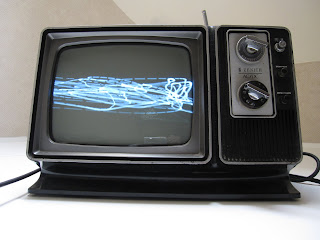
The Talking Television

"The Talking Television" was inspired by "http://www.angelfire.com/80s/sixmhz/tvscope.html.".
If you have an old television, it can be converted into an oscilloscope!. I decided that instead of having waves of lines, I wanted lines that were free and random. The dangerous thing about this, is a television has enough electricity to kill you. The voltage is dangerously BIG (tinker at your own risk). I learned my lesson, I blew out an itouch experimenting. I still consider the project a huge success because the visuals change by pitch and intensity, and the patterns are always new. There is a 1/4 inch out on the side of the T.V so you can plug all kinds of electronics (guitar amps, record players, other T.V's, etc...)


Monday, August 10, 2009

Rufio

Rufio is made from walnut and pine. His arms and legs are jointed with pine dowel. The whole piece was hand carved and took about 20 hours to complete. This project dates back to the winter of 2003 when I was first introduced to carving. I was inspired after seeing a wooden monkey at Tinker Toys in Woodstock NY. I could not afford to buy it at the time so I set my mind to make one.


Friday, July 10, 2009

The Music Box

Michael Schaffer, creator of software program Ardrumo (http://code.google.com/p/ardrumo/), was a great help and inspiration for this project, "The Music Box." Michael made an electronic drum kit using foam circles, some sensors, and an Arduino. Then he wrote a program to translate the sensors into Garageband. The result was a complete homemade drumkit DIY style with the option to change the sounds. I took his sensor idea and built it into a cigar box. All the sensors are hidden, so it makes it more of a mystery music box. It is all self-contained, and the options are endless. I have preset sounds like Mozart the Dove singing, my dog barking, and me whistling. So when I tap on a certain side of the box a different sound plays. Happy birthday Nikola Tesla! :)


Thursday, July 2, 2009

Think Of A Card Box

"Think Of A Card Box" is made inside of a Griffin's cigar box. There are electronics built inside to make the magic part work properly. When you put a quarter in the slot, the lightbulb lights up and the switches begin to work. With a shuffled pack of cards, you have someone think of one as you pass the cards individually between your hands. At the end of the routine the thought-of card is revealed. I love this piece because it combines woodburning, electronics, and magic. The turning handle also reminds me of old-fashioned music boxes.


Friday, June 26, 2009

Digital Scratch Pad

"Digital Scratch Pad" was made using a 555 timer IC . The sound is controlled through a photo-cell which is sensitive to light. As you cover the photo-cell, the the sound gets deeper, and as the cell is exposed to more light, the pitch gets higher. Underneath the felt is a flex sensor. The more pressure you place on the felt, the more it distorts the sound. There is a 1/4 inch jack, so you can plug it into an external speaker to make it louder. I've used this plugged into a Marshall stack, and it sounds awesome.