Showing posts with label electronic art. Show all posts

Wednesday, November 25, 2009

The Jedi Mind Trick

"The Jedi Mind Trick" started with a Star Wars "Return Of The Jedi" soundtrack cassette I found at a thrift store. Playing around with the case, I realized that playing cards fit almost perfectly inside, if you remove a few plastic stubs from the interior. The stand is a soap container from Walmart. A strong LED lights up in the center. The sound is from a musical greeting card. Everything, including the rise of the card, is perfectly synchronized to the music, with the help of a micro-controller.


Friday, September 25, 2009

The Email Notifier


"The Email Notifier" was inspired by:
http://www.j4mie.org/2008/02/15/how-to-make-a-physical-gmail-notifier/ and http://blog.tinyenormous.com/2008/11/25/gmail-notifier-project-for-dummies/

This is something I have been trying to figure out for over three years!. To have physical objects like a bell, lights, and a gauge alert you when you get an email is a really complicated thing to figure out. There is a python script that checks for any new mail. There is also another script that prompts the python script to continuously check for new mail instead of just checking once, and there is a third script written out for a micro-controller to listen, wait, and take action when it receives news. The micro-controller has the bell, lights, and gauge attached to it. It is amazing to see it all in action. The links above only got me so far. I had to write a whole new code for my micro-controller. Once I did that, I was able to add the bell, gauge, and 2 vintage style light-bulbs. The best part about writing the code for the micro-controller was the freedom to make endless patterns. When I get an email now, one light-bulb blinks, then the gauge points to the other light-bulb and it blinks; this is repeated twice and ends with the bell ringing. The casing is from an old alarm clock, the gauge is from a multi-meter, and the electronics are held together by an Arduino and Arduino motor shield. This is by far one of my favorite projects. Any questions about making your own, write me at suitcasemachine@gmail.com. Or, even if you don't have any questions, email me anyway, just to activate The Email Notifier!




Tuesday, September 8, 2009

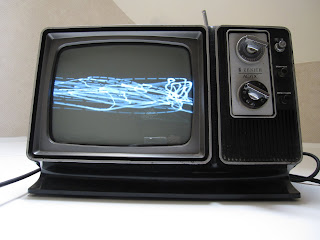
The Talking Television

"The Talking Television" was inspired by "http://www.angelfire.com/80s/sixmhz/tvscope.html.".
If you have an old television, it can be converted into an oscilloscope!. I decided that instead of having waves of lines, I wanted lines that were free and random. The dangerous thing about this, is a television has enough electricity to kill you. The voltage is dangerously BIG (tinker at your own risk). I learned my lesson, I blew out an itouch experimenting. I still consider the project a huge success because the visuals change by pitch and intensity, and the patterns are always new. There is a 1/4 inch out on the side of the T.V so you can plug all kinds of electronics (guitar amps, record players, other T.V's, etc...)


Tuesday, June 16, 2009

Recycled Etcha-Sketcha

The "Recycled Etcha-Sketcha" is mostly made from found or broken electronics. The motors, potentiometers, knobs, and switches came from a broken vintage radio. The wire is from wire hangers, and the light bulb also comes from the radio. The circuits were built using a 555 timer. My favorite part of this project is the last switch on the board. I call it the "crazy switch". When it's turned on, all the electricity flows into the light and the motor, which controls the paper, causing the paper to retract really fast and the light to flash. There is a solenoid motor that also pushes the pen which came from a thrown out printer. 


Friday, May 15, 2009

Heart Box

"Heart Box" was made in a Tic-Tac container. I was inspired by a schematic schowing how to make an LED sensitive to light. There are four photocells that each control two LEDs. The darker it gets at night, the brighter the LEDs shine. Last year, my wife joined  the volunteer 
Emergancy Medical Service for the town we live in, so it was a gift to her. Go Katie! 


Thursday, May 14, 2009

The Audio Portrait Artist

This is "The Audio Portrait Artist"(TAPA). It is made from recycled DC motors, cigar boxes, pieces from a broken multimeter, roof shingles, wine corks, and old radio knobs. TAPA works similar to a CNC machine, but instead of cutting things, it draws . There are four microphones which are each individually filtered to sense a certain range of sound. Starting from very low deep sounds to high pitches, TAPA draws in a specific direction based on the pitch it hears. There are four control knobs on top to control the sensitivity of each mic. Each microphone is individually amplified using LM386N IC chips, and a ULN2003A IC chip bring both DC motors together. There are two relays that control the direction for both motors. The analog gauge is wired together with the circuit to show the intensity of sound it receives.


Wednesday, May 13, 2009

The Lie Detector

The Lie Detector is made with two recycled DC motors from old printers. The circuit is made up of a triple 5 timer and two transistors for the hand sensor. The buzzer goes off when it gets a strong enough signal coming from the sensor. The more your hand sweats, the stronger the pen moves and buzzer sounds. I love this project because I'm finally branching away from microcontrollers.